The Thoroughbred horse is a breed developed specifically for athletic performance and speed racing. Centuries of selective breeding have resulted in an agile equine of immense economic value in the international market.
Understanding its morphological features and history is a necessary first step before considering the purchase and transport of one of these specimens.
Origin and crossbreeding of the breed in the 18th century
The development of this breed began in Great Britain during the late 17th and early 18th centuries. The main goal for breeders was to produce fast horses for the racing competitions that were gaining popularity in England.
To achieve this, a systematic crossbreeding of local English mares with imported Arabian stallions was carried out. All current genetics of the English Thoroughbred trace back to three founding sires: the Byerley Turk, the Darley Arabian, and the Godolphin Arabian. The result of this breeding program was a purebred with unprecedented athletic capacity for its time.
Physical characteristics and temperament of the equine
The anatomy of the Thoroughbred horse is designed to maximize its power and speed on the track.
Physically, they stand out for having fine limbs supported by a very strong bone structure. They present a long, muscular neck paired with a deep chest, which provides them with superior lung capacity to oxygenate the body during a gallop. Their average height is around 160 centimeters and the most common coat color is bay, although other variations are accepted.
Regarding behavior, it is a highly intelligent animal with a sensitive temperament. They possess high energy and a lively character. Because they react so quickly to stimuli, this breed is not suitable for beginners; they require structured training and the guidance of an experienced rider who knows how to channel their constant state of alertness.
Training as a racehorse
The physical preparation of a Thoroughbred begins unusually early compared to other sport breeds. From eighteen months of age, the foals start a meticulous breaking-in process where they gradually become accustomed to the bit, the rider’s weight, and the unique environment of the racetrack starting gates.
Given their rapid muscular development, by the age of two, many of these horses are already competing in official speed races. This high level of demand requires the daily work of a multidisciplinary team, including trainers, work riders, and veterinarians, focused on maximizing performance and preventing joint injuries.
The importance of a stallion in genetics and breeding
The true driving force of this industry lies not only in betting but in selective breeding. A horse that proves to be a champion in major international classics increases its value exponentially upon retiring from the track to begin its career as a stallion.
This business model relies on Stud Fees, where mare owners pay considerable sums for a single service. Therefore, stud farms operate as high-security facilities equipped with advanced veterinary technology, ensuring the birth of foals that will be strictly registered in the official Stud Book.
Horses retired from the track
The athletic career on racetracks is usually brief, forcing many of these horses to retire from high-level competition between four and six years of age. This situation has driven a very active international secondary market known as OTTB (Off-The-Track Thoroughbreds).
For private riders, acquiring a retired Thoroughbred represents an excellent opportunity. After a proper retraining period, their intelligence and athletic capacity allow them to excel in new equestrian disciplines, such as show jumping or eventing, giving them a highly fruitful second sporting life.
Purchase and export
Purchasing a racehorse of this caliber usually involves searching specialized stud farms or auctions in England, Ireland, or France. To formalize the transaction, it is essential to validate its pedigree through the official records of the General Stud Book, the British authority that certifies blood purity and the animal’s history.
Relocating a Thoroughbred from abroad
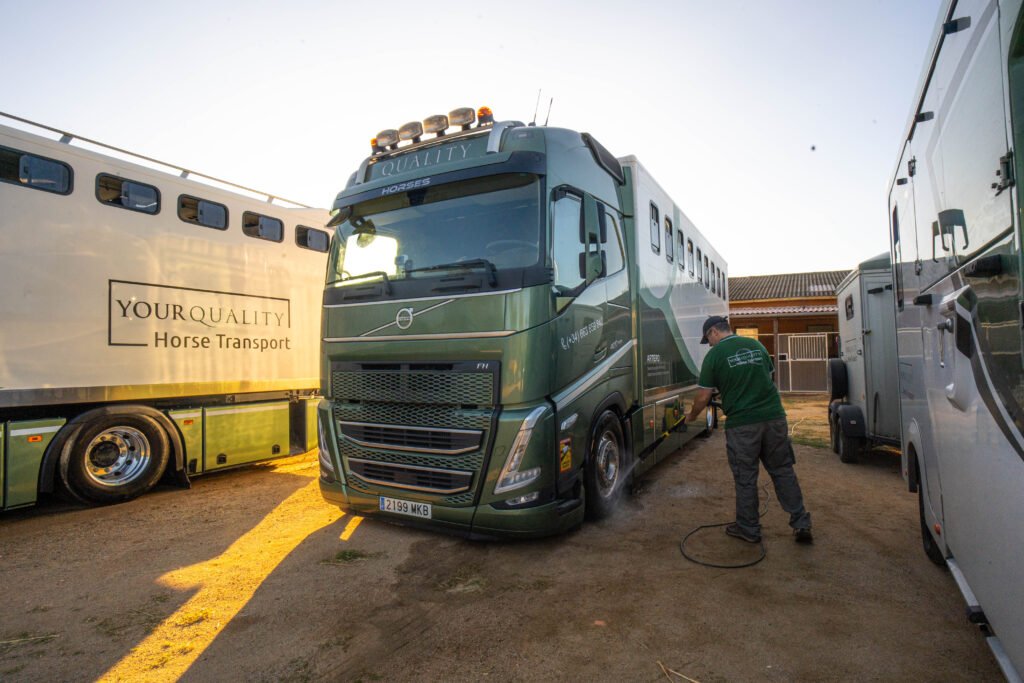
Due to their nervous temperament and high economic value, importing a Thoroughbred from the United Kingdom or the rest of Europe requires impeccable logistics to minimize stress. At Your Quality Horse Transport, we cover regular routes across Europe, ensuring strict compliance with international health and movement regulations for equidae so that your new horse arrives at its destination facilities in optimal conditions.
Frequently Asked Questions (FAQ)
What speed can an English Thoroughbred reach?
In short and middle-distance competitions, a Thoroughbred trained for racing can exceed 60 kilometers per hour. In sections of maximum exertion (the final sprint), some horses have recorded top speeds close to 70 km/h.
What is the difference between a Thoroughbred and an Arabian horse?
While the Arabian horse stands out for its extreme physical endurance to maintain a trot or gallop over very long distances (ideal for disciplines like endurance riding), the English Thoroughbred is genetically optimized for explosive speed and power over shorter or medium distances. Additionally, the Thoroughbred is typically taller.
Is this breed suitable for show jumping or dressage?
Yes. Although their primary origin is speed racing on racetracks, many horses retired from the track are successfully retrained for show jumping or eventing thanks to their strength, flexibility, and long stride.
What special care does this horse breed require?
Due to their accelerated metabolism and thin skin, they require highly controlled diets with high caloric intake if they are kept in competition or constant training. Furthermore, they are prone to suffering from hoof and tendon injuries due to the thinness of their lower limbs, requiring frequent visits to the farrier and rigorous veterinary control.